
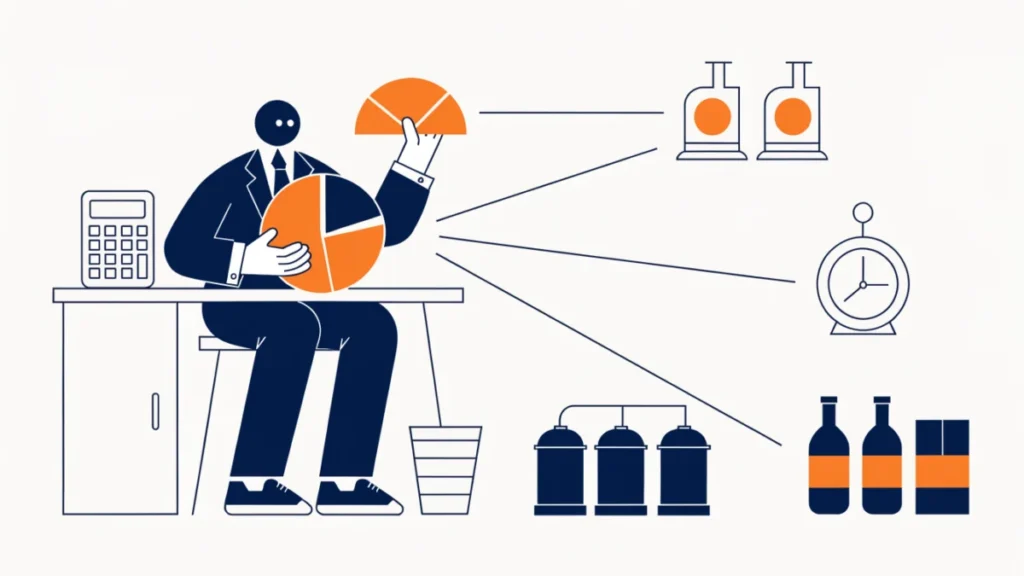
Quick answer: Overheads are all indirect costs: indirect material, indirect labour and indirect expenses. They are classified by behaviour (fixed, variable, semi-variable) and by function (factory, office and administration, selling and distribution). They are first allocated or apportioned to departments, then absorbed into products using a rate such as cost per machine hour.
Overheads are a very important part of cost accounting. Following is the Top Overheads Question Answer.

Overheads in Cost Accounting – Explained
1. What is meant by overheads?
The aggregate of indirect material cost, indirect wages, and indirect expenses is known as overhead.
2. What do you understand by fixed overhead?
Fixed overhead remains unchanged up to a fixed level of production and is related to the time factor rather than the production factor.
3. Explain variable overhead?
The cost which increases or decreases in proportion to production activities is known as variable overhead.
4. What is semi-variable overhead?
Semi-variable overhead is partly fixed and partly variable: it changes with production, but not in direct proportion. Electricity with a fixed monthly charge plus a usage charge is a typical example.
5. Examples of variable overheads?
Following are the variable overheads examples:
- Fuel and power
- Royalty
- Packing expenses
- Commission of traveling agents.
6. Difference between fixed and variable overhead?
- Fixed overhead remain fixed irrespective of changes in production while variable overhead varies in direct proportion to changes in production.
- Fixed overhead is related to time while variable overhead is related to production units.
7. What is meant by the functional classification of overheads?
- Functional classification of overheads are:
- Factory or work overhead
- Office or administration overhead and
- Selling and distribution overhead.
8. Give 5 Examples of Factory Overhead?
- Factory rent, rates, and insurance.
- Factory lighting.
- Work manager salary.
- Depreciation of factory building.
- Drawing office salaries.
9. Give 5 examples of Office Overhead?
- Office rent, rates, and Taxes.
- Staff salaries.
- Printing and stationery.
- Postage and telephone charges.
- Depreciation of office building and furniture.
10. Give 5 examples of Distribution overhead?
- Packing expenses.
- Rent of Warehouse.
- Warehouse insurance.
- Delivery Van expenses.
- Salary of the warehouse watchman.
11. What do you mean by the allocation of overhead?
Allocation is charging a whole item of overhead directly to one cost centre because it clearly belongs there, such as the salary of a supervisor who works only in the machine shop.
12. Explain the apportionment of overhead?
Apportionment is sharing a common overhead among several cost centres on a fair basis, such as factory rent shared by floor area or power shared by machine hours.
13. What do you understand by secondary apportionment?
When the overhead of the service center is apportioned to the production center is known as secondary apportionment.
14. Difference between apportionment and absorption of factory overhead?
Apportionment shares overheads among departments (cost centres) on a suitable basis. Absorption is the next step: it charges each department’s overheads to the products or jobs (cost units) passing through it, using a predetermined rate such as a rate per machine hour or per labour hour.
15. Difference between overhead and cost?
Overhead is only the indirect part of cost: indirect material, indirect labour and indirect expenses. Total cost is wider. It equals prime cost (direct material, direct labour and direct expenses) plus all overheads.
Worked Example: Calculating an Overhead Absorption Rate
A machine shop expects factory overheads of ₹2,40,000 for the year and 12,000 machine hours. The absorption rate is ₹2,40,000 ÷ 12,000 = ₹20 per machine hour. A job that uses 50 machine hours therefore absorbs 50 × ₹20 = ₹1,000 of overhead.
At the year end, if actual overheads were ₹2,52,000 but only ₹2,40,000 was absorbed, overheads are under-absorbed by ₹12,000. If actual overheads were lower than the amount absorbed, they are over-absorbed. The difference is usually adjusted through the costing Profit and Loss Account or a supplementary rate.
Allocation, Apportionment and Absorption at a Glance
| Step | What happens | Example |
|---|---|---|
| Allocation | Whole overhead charged to one cost centre | Machine shop supervisor’s salary to the machine shop |
| Primary apportionment | Shared overheads split among all departments | Factory rent split by floor area |
| Secondary apportionment | Service department costs moved to production departments | Maintenance department costs split by maintenance hours |
| Absorption | Production department overheads charged to products | ₹20 per machine hour charged to each job |