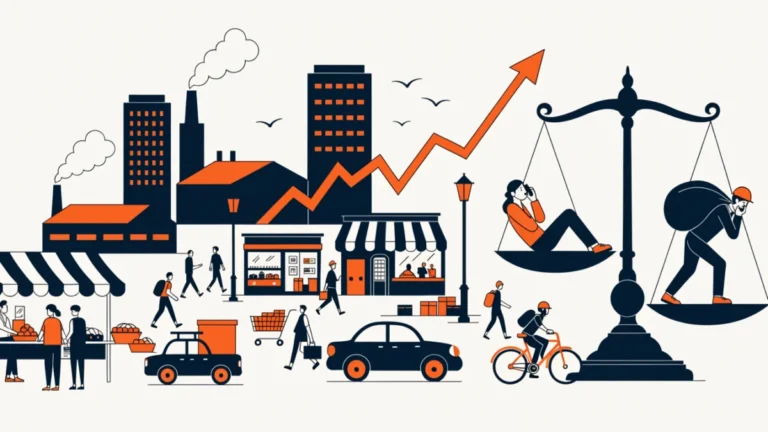

Advantages of a socialist economy: less inequality, basic needs covered, low open unemployment, rapid build-up of heavy industry, no wasteful competition, long-term planning and stability. Disadvantages: weak incentives, no market prices to guide planners (the calculation problem), shortages and queues, bureaucracy, limited consumer choice, concentration of power and slow innovation.
Socialism promises an economy run for everyone rather than for owners of capital. The record is mixed. The Soviet Union turned a largely agricultural country into an industrial power within two decades, yet by the 1980s it struggled to put enough meat and consumer goods in its shops, and the system collapsed in 1991. China kept the Communist Party in charge but began moving to markets in 1978, and its growth took off after that.
Here is a balanced look at what socialism does well and where it tends to fail. For the defining traits, see the characteristics of a socialist economy.
Advantages of a Socialist Economy
1. Less Inequality
With no large private fortunes and state-set wages, gaps between rich and poor are narrower.
2. Basic Needs Covered
Free or cheap education, healthcare and housing reach the whole population. Cuba, despite low incomes, reports life expectancy close to that of the United States.
3. Low Open Unemployment
The state guarantees jobs, so people are rarely without work.
4. Fast Build-Up of Heavy Industry
Planners can push savings into steel, power and machinery. Soviet industrial output grew rapidly during the Five-Year Plans of the 1930s.
5. No Wasteful Competition
There is no duplication of advertising or rival distribution networks for identical products.
6. Long-Term Planning
The state can invest in projects with long payback periods that private firms might avoid.
7. Economic Stability
Without speculative booms and busts, output follows the plan rather than the business cycle.
Disadvantages of a Socialist Economy
1. Weak Incentives
When pay does not reflect effort and firms cannot fail, people and managers have little reason to work harder or innovate.
2. The Calculation Problem
Without market prices, planners cannot know what things are really worth or what people want. Economists Ludwig von Mises and Friedrich Hayek made this argument in the 1920s to 1940s, and chronic shortages in planned economies bore it out.
3. Shortages and Queues
Fixed low prices plus planning errors produced long waits. Soviet citizens could wait years for a car or a flat.
4. Bureaucracy
Huge planning bodies slow decisions and invite corruption.
5. Limited Consumer Choice
People get what planners decide, often in a narrow range of designs and quality.
6. Concentration of Power
When the state owns everything, economic and political power sit in the same hands, leaving citizens little protection.
7. Slow Innovation
State monopolies face no rivals, so new products and methods spread slowly.
Examples Today
| Country | How socialist? |
|---|---|
| Cuba | Mostly state-owned and planned, with some private businesses allowed since 2021 |
| North Korea | Almost fully state-controlled |
| China | Socialist label, but a large private sector and market prices since the 1978 reforms |
| Vietnam | Market reforms since 1986 (Doi Moi), Communist Party rule |
| Nordic countries | Not socialist: market economies with high taxes and generous welfare |
Most countries settled on a middle path. See how India did it in our guide to the mixed economy, and compare with the advantages and disadvantages of capitalism.