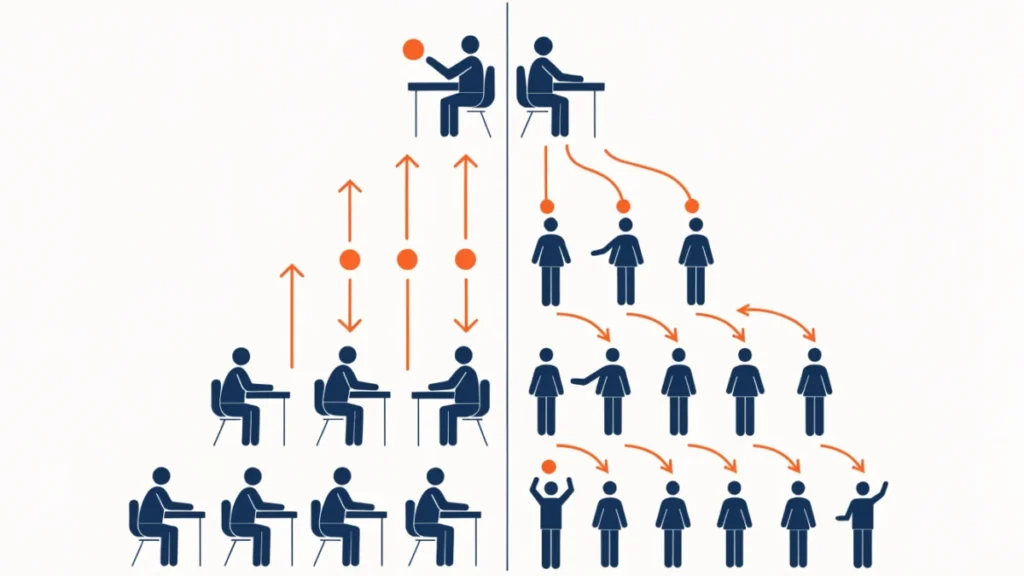
Quick answer: Centralization keeps decision-making authority with top management; decentralization spreads it systematically to lower levels. Centralization gives tight control and consistency and suits small firms or crises, while decentralization gives faster local decisions and develops managers, suiting large or spread-out organisations. Most companies mix both. Delegation is narrower: it is one manager passing authority to a subordinate, while decentralization is organisation-wide.
| Basis | Centralization vs decentralization |
|---|---|
| Authority | Kept at the top vs spread to lower levels |
| Speed | Slower vs faster local decisions |
| Control | High consistency vs needs good reporting |
| Best for | Small firms, crises vs large, diversified firms |
Centralization keeps decision-making authority at the top of the organisation. Decentralization spreads it systematically to lower levels, so managers closest to the work can decide. They are two ends of a scale rather than an either-or choice: most organisations centralise some decisions, such as finance and brand, and decentralise others, such as day-to-day operations.

What is Centralization in Management?
Under centralization, senior managers keep most authority and delegate little. Control and decision-making stay with a few executives. This works well for small firms, start-ups and situations that demand tight control and consistency, such as a crisis or strict regulation. As an organisation grows larger, more complex and more spread out, sending every decision to the top becomes slow, so decision-making usually needs to move closer to operations.
What is Decentralization in Management?
Decentralization is the systematic delegation of authority to every level of the organisation. Decision-making centres are spread across divisions, regions or units, each with real authority within policies set by top management. For example, a retail chain may let store managers decide staffing and local promotions while head office controls pricing policy and suppliers. See the merits and demerits of decentralization for a fuller view.
Centralization vs Decentralization
| Basis | Centralization | Decentralization |
|---|---|---|
| Authority | Kept at the top | Spread to lower levels |
| Decision speed | Slower for local issues | Faster, closer to the action |
| Consistency and control | High | Lower, needs good reporting |
| Best suited to | Small firms, crises, highly regulated work | Large, diversified or geographically spread firms |
| Development of managers | Limited | Strong, managers gain experience |
| Cost | Lower administrative cost | Higher, each unit needs capable managers |
Differences between Delegation and Decentralization
Though decentralization is closely related to delegation the following are some points of difference between the two concepts:
- Delegation refers to the transfer of authority from one individual to another, while decentralization refers to the systematic delegation of authority to all units in an organization widely. It means that decentralization is consistent and wide dispersal of authority throughout the organization.
- The Delegation can take place from one person to another and be a complete process. However, decentralization is complete only when the fullest possible delegation is made to all or most of the people up to the lower level in the organization.
- Delegation is between a superior and a subordinate, while decentralization is organisation-wise delegation between top management and departments of divisions.
- Delegation is necessary for effective management because no individual manager can afford to look after everything. However, decentralization becomes necessary as the organisation grows, driven by by the growth of the organization.
Both affect how the business handles control and decision-making process of business.