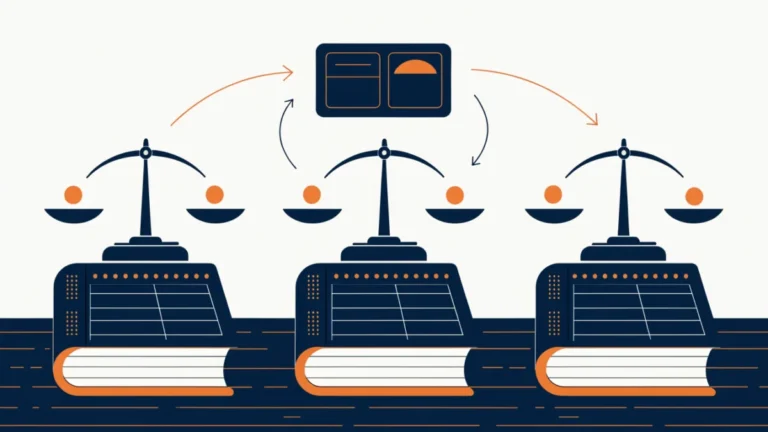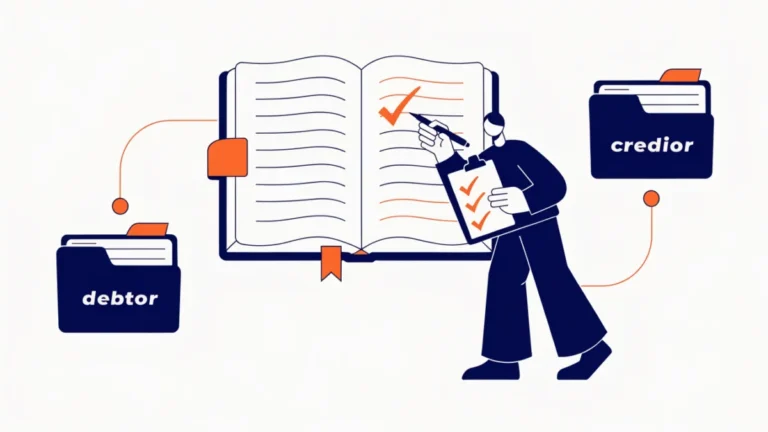

To transfer a balance from one ledger to another, pass a journal entry: debit the account in the ledger receiving the balance and credit the account in the ledger it leaves. For a customer who is also a supplier, debit their purchases ledger account and credit their sales ledger account with the smaller balance. If control accounts are kept, debit Total Creditors and credit Total Debtors by the same amount.
A ledger transfer (often called a contra or set-off entry) moves a balance from one ledger to another. The most common case is a person who is both your customer and your supplier: they appear as a debtor in the sales ledger and as a creditor in the purchases (bought) ledger. Instead of paying each other in full, the smaller balance is set off against the larger one through a journal entry.
When Is a Ledger Transfer Needed?
- Set-off between sales and purchases ledgers: the same party owes you money and is owed money by you.
- Moving an account between sections of a ledger: for example, a customer’s account moved from the A–L sales ledger to the M–Z sales ledger.
- Correcting a posting that was entered in the wrong ledger.
Worked Example: Setting Off a Customer Who Is Also a Supplier
Ramesh Traders buys goods from your firm on credit and also supplies you with packing material. At the month end, Ramesh owes you ₹8,000 (a debit balance in the sales ledger) and you owe Ramesh ₹5,000 (a credit balance in the purchases ledger). Both sides agree to set off the smaller amount, ₹5,000.
| Particulars | Dr. (₹) | Cr. (₹) | |
|---|---|---|---|
| Ramesh Traders A/c (Purchases ledger) | Dr. | 5,000 | |
| To Ramesh Traders A/c (Sales ledger) | 5,000 | ||
| (Being balance in purchases ledger set off against sales ledger balance) |
After this entry the purchases ledger account is closed, and Ramesh still owes you a net ₹3,000 in the sales ledger. Only that net amount needs to be collected.
The Matching Entry in the General Ledger
If the business uses a sectional balancing or self-balancing ledger system, the control accounts must change too, otherwise they will no longer agree with the individual ledgers. The total of the set-off is recorded as:
| Particulars | Dr. (₹) | Cr. (₹) | |
|---|---|---|---|
| Total Creditors A/c (or Bought Ledger Adjustment A/c) | Dr. | 5,000 | |
| To Total Debtors A/c (or Sales Ledger Adjustment A/c) | 5,000 |
This reduces both control accounts by ₹5,000, so they still match the balances in the individual ledgers.
Quick Rules to Remember
| Situation | Entry |
|---|---|
| Debit balance moved out of the sales ledger | Credit the account in the sales ledger; debit the account it moves to |
| Credit balance moved out of the purchases ledger | Debit the account in the purchases ledger; credit the account it moves to |
| Set-off between both ledgers | Debit the purchases ledger account, credit the sales ledger account, for the smaller balance |
| Control accounts (if used) | Debit Total Creditors, credit Total Debtors for the same amount |
A transfer never changes the total amount owed between the two parties; it only moves or nets off balances so that the books show the true position. Always get the other party’s written agreement before making a set-off.