
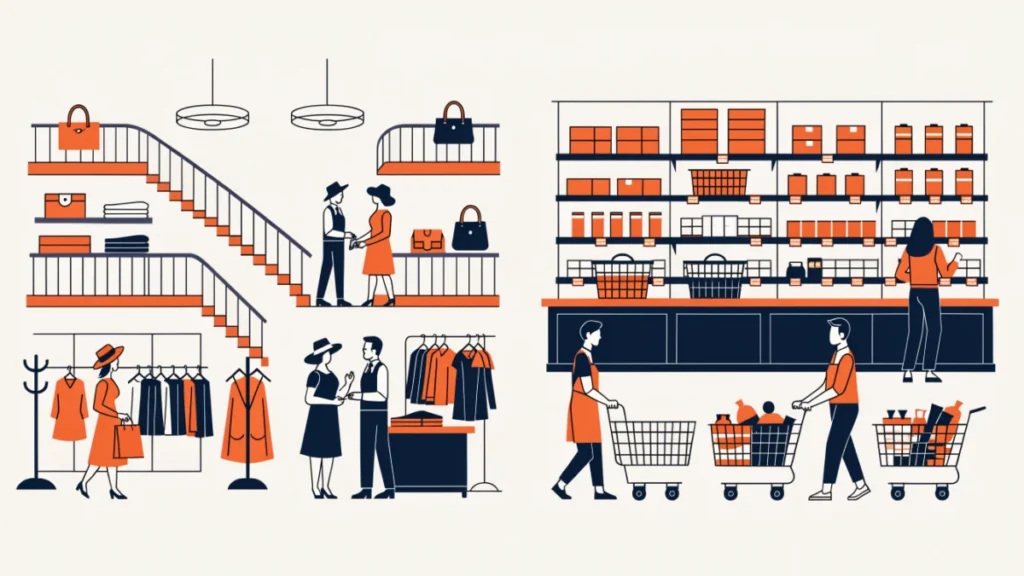
Quick answer: A departmental store sells almost every kind of product under one roof, in separate departments staffed by salespeople, at higher prices with extra services, mainly to middle and upper-income buyers. A supermarket sells mainly groceries and daily-use goods on a self-service basis at lower prices, needs less capital, costs less to run and serves all income groups.
| Basis | Difference |
|---|---|
| Range | Departmental: almost everything. Supermarket: groceries and daily needs |
| Selling | Departmental: salespeople. Supermarket: self-service |
| Prices | Departmental: higher. Supermarket: lower |
| Investment | Departmental: high capital and costs. Supermarket: lower |
| Customers | Departmental: middle and upper income. Supermarket: all classes |
A supermarket is A large retail business unit, selling mainly food and grocery items on the basis of low margin appeal, wide variety and assortments, self-service, and heavy emphasis on merchandise appeal. and A Departmental Store deals with a large number of goods in a large variety.

Difference between Departmental Store and Supermarket
Following are the difference between departmental store and supermarket:
1. Establishment
It is more difficult to establish a Departmental Store then a Supermarket.
It is comparatively easier to establish a Supermarket.
2. Capital
Departmental Store requires more capital to be invested.
Supermarket requires comparatively less amount of capital.
Related: 11 key Difference between Departmental Store and Chain Store (Explain).
3. Goods and Services Offered
Almost all the goods and services of the regular needs of consumers right from ‘Pin‘ to ‘MotorCar‘ are offered in a Departmental Store.
Generally, the goods of the grocery and daily use are provided in a supermarket.
4. Sales Techniques
In the Departmental Store, Goods are sold by a salesman.
in Supermarket, Customers select the goods without any aid from the salesman.
5. Prices of Goods
Prices of goods are generally higher than market prices in Departmental Store.
Prices of goods in a Supermarket are generally lower than market prices.
Related:
- 21 Advantages and Disadvantages of Chain or Multiple Stores.
- 17 Advantages and Disadvantages of Departmental Stores.
- 18 Major Advantages and Disadvantages of Supermarkets.
6. Object
The main object of a Departmental Store is to provide almost all the goods and services under one roof.
The main object of a Supermarket is to provide goods of daily use at reasonable prices.
7. Customers
Customers of a Departmental Store generally belong to the higher and middle-income class.
Customers of a supermarket belong to all the classes. Kirana vs supermarket case study.
8. Cost of Operation
Cost of operation of Departmental Store is very high.
Cost of operation of a Supermarket is comparatively low.
Related: 18 Major Advantages and Disadvantages of Supermarkets.
9. Other Facilities
Many other facilities are provided to customers such as restaurants, restrooms, gift wrapping, alterations and home delivery in a Departmental Store.
No such facility is provided to the customer in the supermarket. Transportation: Importance, Functions, Types, Management (Explained).
Departmental Store vs Supermarket: Comparison Table
| Basis | Departmental store | Supermarket |
|---|---|---|
| Range | Almost everything, from clothing and cosmetics to electronics and furniture | Mainly food, groceries and daily household items |
| Selling method | Sales staff in each department | Self-service with central checkout |
| Prices | Usually higher, with focus on service and brands | Usually lower, based on low margins and high volume |
| Capital and running cost | Very high | Comparatively low |
| Location | City centres and malls | Residential areas and main roads |
| Customers | Mostly middle and higher income | All income groups |
| Extra services | Restaurants, restrooms, gift wrapping, alterations, home delivery | Few beyond parking and home delivery |
| Examples in India | Shoppers Stop, Lifestyle | DMart, Reliance Smart, More |
In practice the line is blurring: many supermarkets now carry clothing and electronics, and many department stores have food halls. The core difference remains the selling method and price position.